

- by Christian Dini
- 16. October 2024
Because of their advantages over standard electric wire and cable, laminated busbars and flat wire are now used extensively in modern power distribution systems in applications such as electric vehicles, solar & wind energy systems, data centres, and industrial machinery.
However, a major challenge in using these conductors in mass production is the need for a fast, clean and accurate process to remove sections of the insulation to ensure a clean and precise electrical connection with electrical components.
In this blog, we look at how Luxinar’s CO2 lasers are addressing these challenges and helping companies across multiple sectors to modernise their manufacturing processes and stay ahead of the curve in an increasingly competitive market.
A brief history of busbars
1500 ampere copper busbars within a power distribution rack for a large building
The term ‘bus’ derived from omnibus (meaning ‘for all’ in Latin) a term coined by Stanislas Baudry who introduced the first public bus system in Nantes, France, in 1826. In the same way, busbars can carry all the currents in a particular system, because compared with cables their wide and flat design offers much more surface area for conducting the electricity.
As a side note, for similar reasons, the term ‘bus’ was adopted by computer designers in the 1970s as the name for a component that connects various subsystems, allowing data and instructions to flow between them.

Types of busbars and their applications
Compared with standard electrical cable, busbars provide numerous advantages such as improved electrical efficiency, easier installation, and greater flexibility, especially in environments that require high power distribution and scalability.
As a result, busbars are now essential components in electrical power distribution systems, with applications in buildings and data centres, and for managing the high currents that flow between the battery, inverter, and motor in electric vehicles.
Busbars are typically flat or rectangular in shape, made from copper or aluminium. Although aluminium has a lower conductivity than copper, it is both cheaper and lighter, which is advantageous in applications where weight and cost are significant considerations such as solar or wind farms and in electric vehicle production.
Busbar dimensions and lengths are tailored to the specific power requirements of the system. In high-power industrial applications, for example, busbars must handle large currents of between 1000 and 5000A and offer low resistance. Busbars also need to carry large amounts of current in renewable energy systems due to the power generated by solar panels, wind turbines, and energy storage systems. Standard dimensions for these applications are 2-6m long, 5-50cm wide and 6mm-2cm thick, depending on current load.
For automotive applications, particularly in electric vehicles (EVs) and hybrid systems busbars need to be lightweight and flexible with a current capacity from 100 to 800A, depending on the design of the battery system and output of the motor. In EV production, busbar material is often supplied in long lengths on a spool, just like a traditional wire. The carmaker cuts off the length(s) they require and bends it to the necessary shape, which can be quite complex because the busbars to be routed around a variety of other parts and structures within the car to get the power to where it’s needed.


Challenges for busbars in mass production
While most industrial busbars are unlaminated, the busbars used in electric vehicles, solar & wind energy systems, data centres, and some types of industrial machinery are typically covered with insulation to prevent accidental contact, ensure safety, and improve performance by minimising the risk of short circuits or electrical interference.
However, at the connection points where busbars meet electrical components like transformers, circuit breakers, or distribution boards, it’s necessary to remove sections of this insulation to expose the conductive material and ensure a clean and precise electrical connection.
Traditionally, this stripping process has been performed using mechanical tools, such as knives or specialised cutting equipment. But the drawbacks with these methods are that they can lead to inconsistent results, potential damage to the busbar, and a slower production process, as well as having limitations in accessing small or complex areas.
Luxinar’s solution: high-speed CO2 laser busbar stripping
In recent years, Luxinar has made significant strides in busbar stripping by laser ablation. Our CO2 lasers are optimised to improve precision, efficiency, and reliability in busbar de-coating processes, especially for industries like automotive, electronics, and energy.
CO2 lasers are ideal for busbar ablation because they produce far-infrared light, which is very strongly absorbed by most of the plastics used for insulation, but highly reflected by the copper. This means that the laser light rapidly vaporises the insulation, but then automatically stops removing material when it reaches the conductor because the copper reflects the laser light back rather than absorbing it.
Our CO2 laser-based de-coating methods therefore ensure that the conductive material beneath is not damaged, maintaining the integrity of the busbar for use in power distribution systems, which is particularly critical in applications requiring high conductivity and low resistance, such as electric vehicles and renewable energy systems.
Laser ablation is a digital process, and therefore extremely flexible; changes in the design and geometry of the busbars can be implemented immediately, with no need for costly new tooling. Furthermore, as the laser process is contactless, stoppages due to tool wear and breakage are eliminated, drastically reducing downtime and production time loss as a result.
In summary, the key advantages of Luxinar’s de-coating methods are:
- Precision and control: Luxinar’s lasers allow for fine control over the depth and area of the material being stripped or de-coated.
- Non-contact process: The laser does not physically touch the wire or busbar, reducing the risk of mechanical damage.
- Speed and efficiency: A galvanometer scanner passes the laser beam rapidly over the required area so that two lasers can be used to process all sides simultaneously. This high-speed laser process can dramatically reduce production times while ensuring high-quality results.
- Environmental benefits: The process is clean, producing minimal waste compared with mechanical methods.

Luxinar’s recommended products for busbar stripping
A popular choice for busbar stripping is Luxinar’s OEM series of sealed CO2 lasers, which range in power from 450-1000W and come in 10.6, 10.25, and 9.3µm wavelengths.
Busbar stripping requires the laser parameters such as power, mode, wavelength, and polarisation, to be very stable. For this reason, Luxinar’s sealed OEM CO2 lasers incorporate unique cavity and electrode designs to ensure the required level of stability and pulse-to-pulse consistency. Additionally, they have a high quality, round, symmetrical beam for high processing speeds, and a short optical pulse with high peak power, which combine to ensure optimum process quality and minimise the heat-affected zone.
Furthermore, our OEM CO2 laser sources are based on the well-proven slab principle, with no need for gas recirculation equipment such as vacuum pumps or pressure control systems. As gas exchange is unnecessary before 20,000 operational hours, the running, maintenance, and service costs of our lasers are minimal – resulting in a long lifetime and trouble-free operation throughout.
They are also a compact solution that can be easily integrated into industrial processing production lines as the OEM series can be sited in confined spaces in any orientation with or without covers.
Wire stripping
Luxinar CO2 lasers are also particularly well-suited for wire stripping, as they provide a non-contact solution that accurately removes insulation without damaging the underlying conductive material. This process is ideal for delicate or complex wires, such as those found in the aerospace or medical device industries. The laser’s precision allows for high-quality, consistent results, even with very fine wires or intricate designs.
A case in point is flat wire, a type of electrical wire that is flat in shape rather than round. It is often used in applications like transformers and inductors where space is limited or where a flat surface area is beneficial for heat dissipation and efficient power flow. Flat wire can be made from various materials such as copper or aluminium and is typically insulated to prevent electrical shorts or interference.
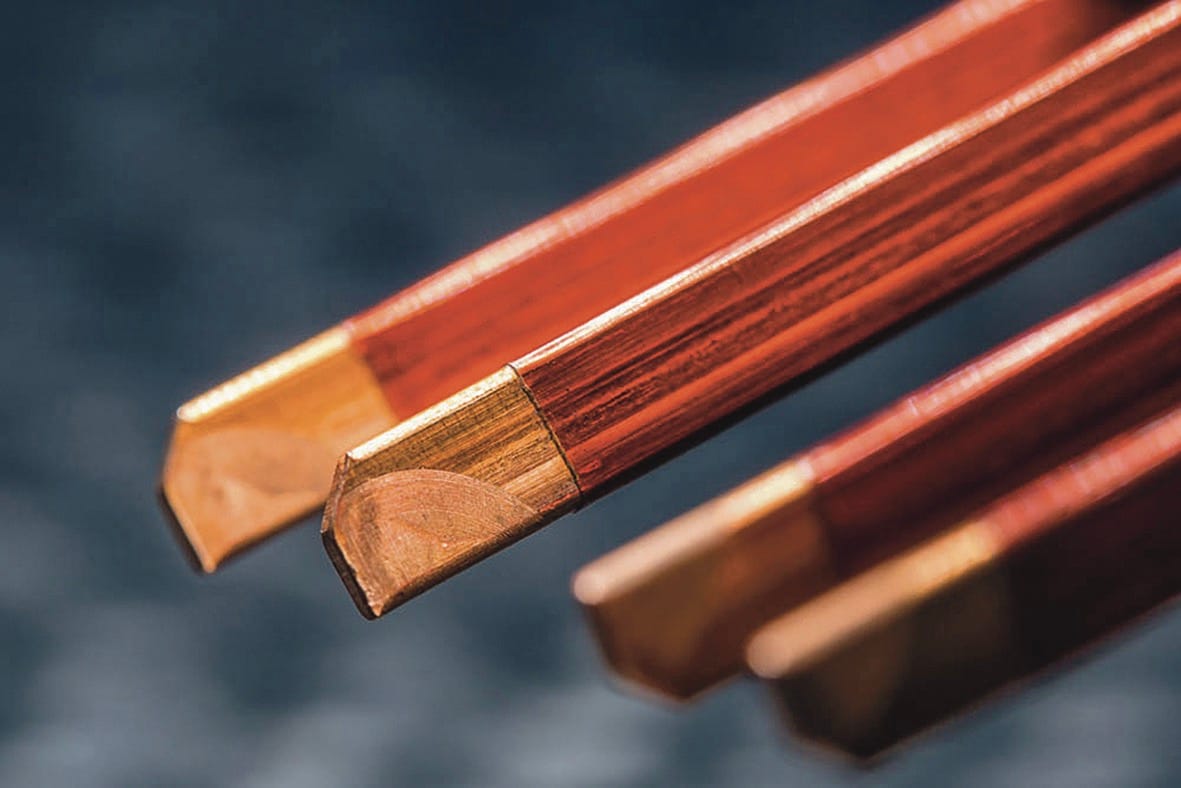
Another type of wire are “hairpins”, rectangular copper wires up to 6mm wide coated with a dielectric enamel (PEEK, PFA-PI, PA), to provide electrical isolation for electric vehicle motors; this enamel must be partially removed so that the hairpins can be welded for electrical contacting. As with busbars, laser processing is contactless, without ablation or loss of copper, and with very little downtime or tooling needed for any changes.
Luxinar’s CO2 laser ablating process for hairpins is also a fast process as a galvanometer scanner passes the laser beam rapidly over the required area, with the hairpin positioned at an angle; in this way, two lasers can be used to process all sides simultaneously. Removal rates depend on the type and thickness of coating, as well as the coating method (cross layer), but the use of a CO₂ laser ensures no material loss of the conductive metal.


Luxinar’s recommended products for wire stripping
A good choice for wire stripping is Luxinar’s SR series of sealed CO2 lasers. They come in three wavelengths: 10.6, 10.25, and 9.3μm, and are integrated with field replaceable RF power supplies. The minimum shipment power is 20% higher than rated power and this series can be easily integrated into laser-based processing machines.
As with the OEM series, our sealed SR laser sources are based on the well-proven slab principle, with no need for gas recirculation equipment such as vacuum pumps or pressure control systems. Gas exchange is unnecessary before 20,000 operational hours, so that the running, maintenance, and service costs of our lasers are minimal – resulting in a long lifetime and trouble-free operation throughout.
Another option is Luxinar’s 125W CO₂ laser systems, the MULTISCAN® HE and MULTISCAN® VS.
These systems each comprise a 125W laser with an articulated beam delivery arm, galvanometer scanner and control software. The process is the same as with the SR series except that the MULTISCAN® has a built-in galvanometer, which passes the laser beam rapidly over the required area, and in this way two lasers can be used to process all sides simultaneously.
Future outlook
According to a recent market report1, the global laminated busbar market is estimated to grow from $863 million in 2023 to $1,296 million by 2030, growing at a CAGR of 6.0%, driven by a focus on renewable energy and increased demand for electric vehicles and advanced charging stations2.
Increased demand for EV motors and other electromechanical systems used in renewable energy is also predicted to drive the global enamelled copper flat wire market – from US$ 418.7 million in 2023 to US$ 556.8 million by 20303.
These market trends suggest that the future of wire stripping and busbar de-coating using CO2 lasers is exceptionally promising. With ongoing advancements in precision, speed, automation, and environmental sustainability, CO2 laser technology is poised to become the gold standard in these processes. And as industries continue to demand higher efficiency and flexibility, particularly in areas like electric vehicles, renewable energy, and advanced electronics, Luxinar’s CO2 lasers will enable manufacturers to meet these challenges head-on, delivering faster, cleaner and more accurate manufacturing processes, with better quality control.
Could a laser be used to improve your manufacturing process?
We can help you to find out by testing samples of your material or product in one of our applications labs. Our applications lab facilities are open to both new and existing customers and OEMs. In addition to wire & busbar stripping, our laboratories are well equipped to carry out a range of other processes including cutting, marking, engraving, drilling, scribing and more.
We offer rapid sample turnaround times, detailed application reports, and complimentary advice from our experienced applications engineers.
Whatever your process, we can help you to determine the best laser for your application. For more details, please contact Dr Louise May, Luxinar’s senior applications engineer at info@luxinar.com.